---
title: "New Indices of Deprivation 2025 Data: MSOA level"
description: "IoD data aggregated to Middle layer Super Output Area"
date: today
categories: [data-analysis, place-based-change]
echo: false
draft: false
image: "/assets/images/blog/imd25-msoa.png"
code-tools:
source: true
toggle: true
# code-fold: true
# code-summary: "Code For Nerds"
---
# New Indices of Deprivation 2025 Data: MSOA level
<div style="text-align: center;">
<p><strong>*27 November 2025*</strong></p>
</div>
```{python}
# Preliminaries
import psycopg2
import configparser
import os
import requests
import pandas as pd
from sqlalchemy import create_engine
import matplotlib.pyplot as plt
from sqlalchemy import create_engine
import janitor
import matplotlib as mpl
import pickle
import geopandas as gpd
import matplotlib.colors as mcolors
# Load DB config
config = configparser.ConfigParser()
config.read(os.path.join('..','db_config.ini'))
db_params = dict(config['postgresql'])
# Build SQLAlchemy connection string
conn_str = (
f"postgresql+psycopg2://{db_params['user']}:{db_params['password']}"
f"@{db_params['host']}:{db_params['port']}/{db_params['database']}"
)
# Create engine
engine = create_engine(conn_str)
# Colours
with open(os.path.join('..','assets','palettes', 'jk_primary_colours.txt'), 'r') as file:
jk_colours = [line.strip() for line in file]
# ice swatch
filepath = os.path.join('..', 'assets','palettes', 'ice_swatch.txt')
with open(filepath, 'r', encoding='utf-8') as file:
ice_swatch = [line.strip() for line in file if line.strip()]
# Make a colormap
ice_cmap = mcolors.LinearSegmentedColormap.from_list("ice", ice_swatch)
ice_cmap_rev = mcolors.LinearSegmentedColormap.from_list("ice", ice_swatch).reversed()
mpl.rcParams['font.family'] = 'Open Sans'
mpl.rcParams['font.size'] = 16
mpl.rcParams["figure.facecolor"] = jk_colours[0]
```
```{python}
# Get Iod Data from source
data_dir = os.path.join('data')
filepath = os.path.join(data_dir, 'iod25.csv')
url = 'https://assets.publishing.service.gov.uk/media/68ff5daabcb10f6bf9bef911/File_7_IoD2025_All_Ranks_Scores_Deciles_Population_Denominators.csv'
if os.path.isfile(filepath)==False:
response = requests.get(url)
with open(filepath, 'wb') as file:
file.write(response.content)
# else:
# print('Data already acquired. Loading it.')
iod25 = pd.read_csv(filepath)
# Clean column names
iod25 = janitor.clean_names(iod25)
iod25.columns = iod25.columns.str.strip('_')
domains_of_interest = [
'index_of_multiple_deprivation',
'income',
'employment',
'education_skills_and_training',
'health_deprivation_and_disability',
'crime',
'barriers_to_housing_and_services',
'living_environment',
'income_deprivation_affecting_children',
'income_deprivation_affecting_older_people',
'children_and_young_people_sub-domain',
'adult_skills_sub-domain',
'geographical_barriers_sub-domain',
'wider_barriers_sub-domain',
'indoors_sub-domain',
'outdoors_sub-domain',
]
def clean_domain_name(domain):
return domain.replace('_', ' ').title()
domain_dict = {domain: clean_domain_name(domain) for domain in domains_of_interest}
# Reorder columns
cols = [
col for col in iod25.columns
if 'score' in col
and any(domain in col for domain in domains_of_interest)
]
population_cols = [
col for col in iod25.columns
if ('population' in col)
or ('dependent_children' in col)
]
iod25 = iod25.rename(
columns = {
'lsoa_code_2021': 'lsoa21cd',
'lsoa_name_2021': 'lsoa21nm',
'local_authority_district_code_2024': 'lad24cd',
'local_authority_district_name_2024': 'lad24nm',
})
iod25 = iod25[['lsoa21cd','lsoa21nm','lad24cd','lad24nm'] + cols + population_cols]
```
```{python}
# Get the lookup from LSOA to MSOA. This is from our DB.
# Lookups are available at ONS geoportal, e.g. https://geoportal.statistics.gov.uk/datasets/45fdd4465604493cb7d2238ad642172b_0/explore
filepath = os.path.join(data_dir, 'lsoa_msoa21_lookup.pkl')
if not os.path.isfile(filepath):
with engine.connect() as con:
query = '''SELECT DISTINCT lsoa21cd, msoa21cd
FROM pcode_census21_lookup
'''
lookup21 = pd.read_sql(query, con = con)
with open(filepath, 'wb') as file:
pickle.dump(lookup21, file)
else:
with open(filepath, 'rb') as file:
lookup21 = pickle.load(file)
iod25_msoa = iod25.copy()
iod25_msoa = iod25_msoa.merge(lookup21, how='left', on='lsoa21cd')
cols = iod25_msoa.columns[iod25_msoa.columns.str.contains('score')]
# Note - denominator may need to be different for particular domains
# Create a dictionary to index the correct population column
# These are metrics with specific denominators
special_cols = [
'income_deprivation_affecting_children_index_idaci_score_rate',
'income_deprivation_affecting_older_people_idaopi_score_rate',
'employment_score_rate'
]
# These are the metrics with the general pop denominator
normal_cols = [col for col in cols if col not in special_cols]
# Map the special metrics to specific denoms
pop_dict = {
'income_deprivation_affecting_children_index_idaci_score_rate': 'dependent_children_aged_0_15_mid_2022',
'income_deprivation_affecting_older_people_idaopi_score_rate': 'older_population_aged_60_and_over_mid_2022',
'employment_score_rate': 'working_age_population_18_66_for_use_with_employment_deprivation_domain_mid_2022'
}
# Map the normal metrics to the total pop denom
temp_dict = {col: 'total_population_mid_2022' for col in normal_cols}
# Add the two dicts
pop_dict.update(temp_dict)
# Multiply each score by population
for col in cols:
population_col = pop_dict[col]
# print(col)
# print(population_col)
iod25_msoa[col + '_weighted'] = iod25_msoa[col] * iod25_msoa[population_col]
# Group by MSOA and sum the weighted scores and population
grouped = iod25_msoa.groupby(['msoa21cd','lad24cd','lad24nm']).agg(
{col + '_weighted': 'sum' for col in cols} |
{'total_population_mid_2022': 'sum',
'dependent_children_aged_0_15_mid_2022': 'sum',
'older_population_aged_60_and_over_mid_2022': 'sum',
'working_age_population_18_66_for_use_with_employment_deprivation_domain_mid_2022': 'sum'}
).reset_index()
# Calculate weighted average, rank, and decile
for col in cols:
avg_col = col + '_weighted_avg'
rank_col = col + '_rank'
decile_col = col + '_decile'
population_col = pop_dict[col]
# print(col + ': ' + population_col)
# print(grouped[population_col])
grouped[avg_col] = grouped[col + '_weighted'] / grouped[population_col]
grouped[rank_col] = grouped[avg_col].rank(method='min', ascending=False)
grouped[decile_col] = pd.qcut(grouped[rank_col], q=10, labels=range(1, 11), duplicates='drop')
# Select final columns to keep
iod25_msoa = grouped[['msoa21cd','lad24cd','lad24nm'] +
[col + suffix for col in cols for suffix in ['_weighted_avg', '_rank', '_decile']]]
iod25_msoa.to_csv(os.path.join('data','iod25_msoa.csv'), index=False)
```
```{python}
#| include: false
# a quick sanity check that ranks are lower for higher scores
test_cols = [col for col in iod25_msoa.columns if 'index_of_multiple_deprivation_imd' in col]
test = iod25_msoa[['msoa21cd'] + test_cols]
test.sort_values([col for col in test.columns if 'weighted_avg' in col])
```
```{python}
# Get msoa geometries and lookup for plotting the data on a map
filepath = os.path.join(data_dir,'msoa_geometries.pkl')
if os.path.isfile(filepath)==False:
with engine.connect() as con:
query = '''
WITH lookup AS (
SELECT DISTINCT msoa21cd, lad21cd
FROM pcode_census21_lookup)
SELECT lookup.*, foo.geometry
FROM msoa21_boundaries foo
LEFT JOIN lookup
ON foo.msoa21cd = lookup.msoa21cd
'''
msoa_geometries = gpd.read_postgis(sql=query, con=con, geom_col='geometry')
with open(filepath, 'wb') as file:
pickle.dump(msoa_geometries, file)
else:
with open(filepath, 'rb') as file:
msoa_geometries = pickle.load(file)
iod25_msoa_gpd = msoa_geometries.merge(iod25_msoa, how='right', on='msoa21cd')
```
```{python}
# Plot the MSOA map as an illustration
from mpl_toolkits.axes_grid1.axes_divider import make_axes_locatable
import contextily as cx
fig, ax = plt.subplots(figsize=(8,8))
target_variable = 'index_of_multiple_deprivation_imd_score_decile'
# Data range
target_max = iod25_msoa_gpd[target_variable].max()
target_min = iod25_msoa_gpd[target_variable].min()
target_range = target_max - target_min + 1
# Create discrete colormap
colors = [ice_cmap_rev(i/target_range) for i in range(target_max)] # sample 10 discrete colors - using i/9 ensures last colour is used
cmap_discrete = mpl.colors.ListedColormap(colors)
# Use a simple normalize from 1 to 10
norm = mpl.colors.Normalize(vmin=target_min, vmax=target_max+1) # could be +1?
iod25_msoa_gpd.plot(
column=target_variable,
ax=ax,
cmap=ice_cmap_rev)
plt.title('Index of Multiple Deprivation 2025: MSOAs', ha='center')
sm = mpl.cm.ScalarMappable(cmap=cmap_discrete, norm=norm)
sm._A = []
divider = make_axes_locatable(ax)
cax = divider.append_axes("right", size="5%", pad=0.1)
# Create colorbar
cbar = fig.colorbar(sm, cax=cax)
# Set custom ticks at bin centers
tick_positions = [i + 0.5 for i in range(target_min, target_max+1)] # 1.5, 2.5, ..., 9.5
cbar.set_ticks(tick_positions)
cbar.set_ticklabels(range(target_min, target_max+1)) # label them 1–10
cbar.set_label('Decile')
ax.set_axis_off()
plt.tight_layout()
cx.add_basemap(ax=ax, crs=iod25_msoa_gpd.crs, source=cx.providers.CartoDB.Positron)
# fig.savefig(os.path.join('..','assets','images','blog','imd25-msoa.png'),bbox_inches='tight', dpi=300)
```
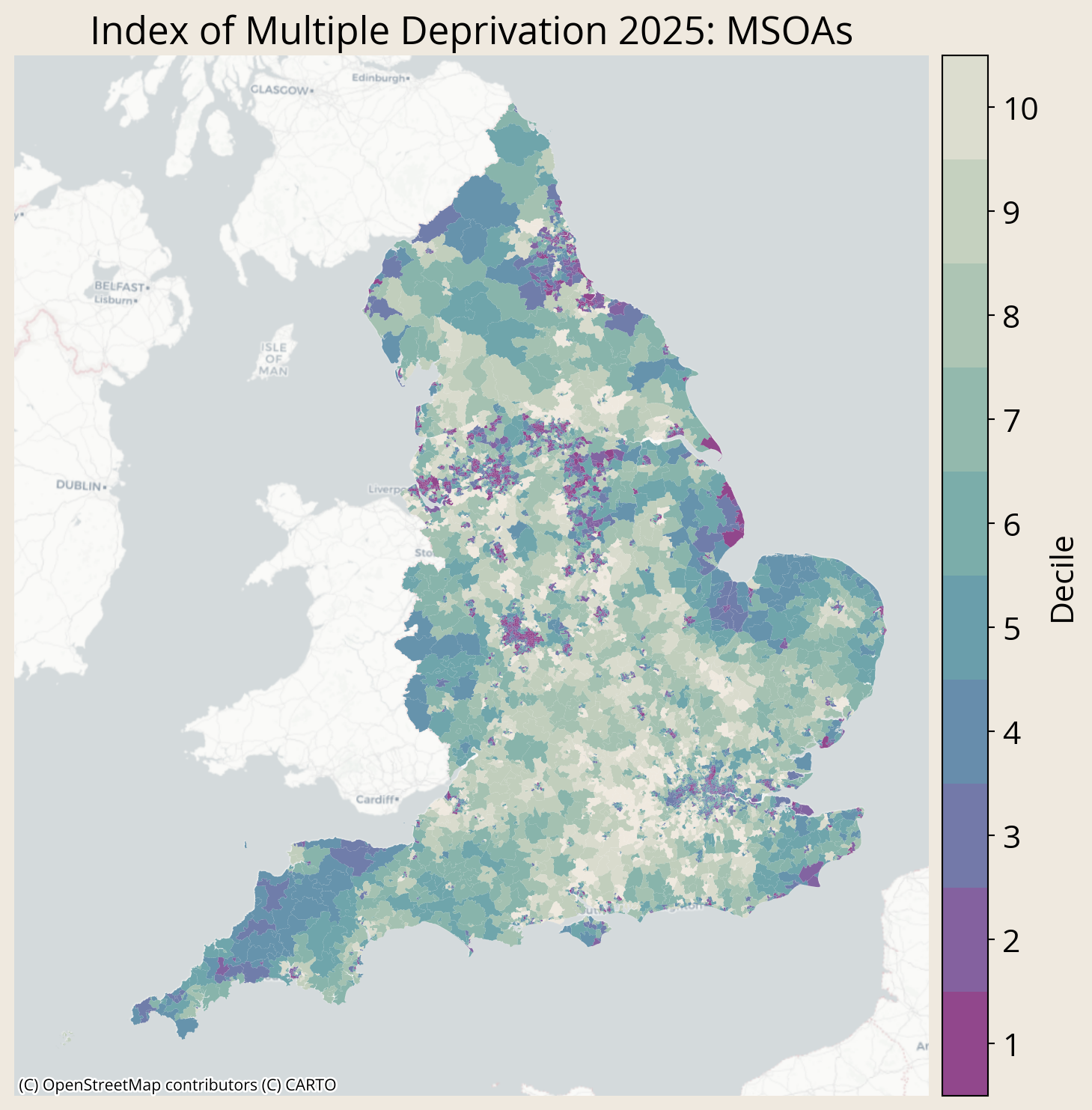
New [Indices of Deprivation data](https://www.gov.uk/government/statistics/english-indices-of-deprivation-2025) were released in November 2025. These data provide measures of deprivation in areas relative to other areas in England. The data have been published for Lower layer Super Output Areas (LSOAs) and Local Authority Districts, as well as other area types. However, we've noticed that the data haven't been published at Middle layer Super Output Area (MSOA).
In our recent project [Understanding Poverty in Place](https://justknowledge.org.uk/case-studies/child-poverty-analysis.html), we aggregated deprivation data to MSOA level (the estate of Northumberland Park can be defined as a single MSOA), and we'd like to share this aggregated dataset in case it's of use to others.
<div style="text-align: center;">
<a href="https://github.com/JustKnowledge-UK/public-downloads/releases/download/data-release/iod25_msoa.csv" download>
<img src="../assets/images/shared/new-knowledge-icon.svg" alt="New Knowledge Icon" style="margin-top: 20px;"/>
</a>
<p><strong>Download the MSOA level data</strong></p>
</div>
## More information on how we aggregated these data
To aggregate LSOA data to MSOA, we followed the guidance set out in Appendix A of the [English Indices of Deprivation Research Report](https://www.gov.uk/government/publications/english-indices-of-deprivation-2025-research-report). In brief, the process involves:
1. Creating population weights for each LSOA by dividing the population of each LSOA by the total population of its corresponding MSOA (note some population denominators are specific populations, e.g. children, older people, employed people)
2. Multiplying the LSOA deprivation scores by their population weights
2. Summing the weighted scores of LSOAs for each MSOA
The result is a population-weighted score for each MSOA, where each LSOA's contribution is weighted by how big its population is relative to the MSOA's total population.
For each deprivation metric, we then ranked the MSOAs and allocated each MSOA to a decile, where lower ranks and deciles correspond to greater deprivation.
Below is the code used to aggregate the LSOA data to MSOA.
```{python}
#| output: false
#| include: true
#| echo: true
#| code-fold: true
#| code-summary: "Code for Nerds"
# Preliminaries
import psycopg2
import configparser
import os
import requests
import pandas as pd
from sqlalchemy import create_engine
from sqlalchemy import create_engine
import janitor
import pickle

# Load DB config
config = configparser.ConfigParser()
config.read(os.path.join('..','db_config.ini'))
db_params = dict(config['postgresql'])

# Build SQLAlchemy connection string
conn_str = (
    f"postgresql+psycopg2://{db_params['user']}:{db_params['password']}"
    f"@{db_params['host']}:{db_params['port']}/{db_params['database']}"
)

# Create engine
engine = create_engine(conn_str)

# Get Iod Data from source
data_dir = os.path.join('data')

filepath = os.path.join(data_dir, 'iod25.csv')

url = 'https://assets.publishing.service.gov.uk/media/68ff5daabcb10f6bf9bef911/File_7_IoD2025_All_Ranks_Scores_Deciles_Population_Denominators.csv'

if os.path.isfile(filepath)==False:
    response = requests.get(url)
    with open(filepath, 'wb') as file:
        file.write(response.content)
# else:
    # print('Data already acquired. Loading it.')

iod25 = pd.read_csv(filepath)

# Clean column names
iod25 = janitor.clean_names(iod25)
iod25.columns = iod25.columns.str.strip('_')

domains_of_interest = [
    'index_of_multiple_deprivation',
    'income',
    'employment',
    'education_skills_and_training',
    'health_deprivation_and_disability',
    'crime',
    'barriers_to_housing_and_services',
    'living_environment',
    'income_deprivation_affecting_children',
    'income_deprivation_affecting_older_people',
    'children_and_young_people_sub-domain',
    'adult_skills_sub-domain',
    'geographical_barriers_sub-domain',
    'wider_barriers_sub-domain',
    'indoors_sub-domain',
    'outdoors_sub-domain',
]

def clean_domain_name(domain):
    return domain.replace('_', ' ').title()
domain_dict = {domain: clean_domain_name(domain) for domain in domains_of_interest}

# Reorder columns
cols = [
    col for col in iod25.columns
    if 'score' in col
    and any(domain in col for domain in domains_of_interest)
]

population_cols = [
    col for col in iod25.columns
    if ('population' in col)
    or ('dependent_children' in col)
]

iod25 = iod25.rename(
    columns = {
    'lsoa_code_2021': 'lsoa21cd',
    'lsoa_name_2021': 'lsoa21nm',
    'local_authority_district_code_2024': 'lad24cd',
    'local_authority_district_name_2024': 'lad24nm',

    })

iod25 = iod25[['lsoa21cd','lsoa21nm','lad24cd','lad24nm'] + cols + population_cols]

# Get the lookup from LSOA to MSOA. This is from our DB.
# Lookups are available at ONS geoportal, e.g. https://geoportal.statistics.gov.uk/datasets/45fdd4465604493cb7d2238ad642172b_0/explore

filepath = os.path.join(data_dir, 'lsoa_msoa21_lookup.pkl')
if not os.path.isfile(filepath):
    with engine.connect() as con:
        query = '''SELECT DISTINCT lsoa21cd, msoa21cd
                FROM pcode_census21_lookup
            '''
        lookup21 = pd.read_sql(query, con = con)

        with open(filepath, 'wb') as file:
            pickle.dump(lookup21, file)
else:
    with open(filepath, 'rb') as file:
        lookup21 = pickle.load(file)

iod25_msoa = iod25.copy()

iod25_msoa = iod25_msoa.merge(lookup21, how='left', on='lsoa21cd')

cols = iod25_msoa.columns[iod25_msoa.columns.str.contains('score')]

# Note - denominator may need to be different for particular domains
# Create a dictionary to index the correct population column
# These are metrics with specific denominators
special_cols = [
    'income_deprivation_affecting_children_index_idaci_score_rate',
    'income_deprivation_affecting_older_people_idaopi_score_rate',
    'employment_score_rate'
]

# These are the metrics with the general pop denominator
normal_cols = [col for col in cols if col not in special_cols]

# Map the special metrics to specific denoms
pop_dict = {
    'income_deprivation_affecting_children_index_idaci_score_rate': 'dependent_children_aged_0_15_mid_2022',
    'income_deprivation_affecting_older_people_idaopi_score_rate': 'older_population_aged_60_and_over_mid_2022',
    'employment_score_rate': 'working_age_population_18_66_for_use_with_employment_deprivation_domain_mid_2022'
}

# Map the normal metrics to the total pop denom
temp_dict = {col: 'total_population_mid_2022' for col in normal_cols}

# Add the two dicts
pop_dict.update(temp_dict)

# Multiply each score by population
for col in cols:
    population_col = pop_dict[col]
    # print(col)
    # print(population_col)
    iod25_msoa[col + '_weighted'] = iod25_msoa[col] * iod25_msoa[population_col]

# Group by MSOA and sum the weighted scores and population
grouped = iod25_msoa.groupby(['msoa21cd','lad24cd','lad24nm']).agg(
    {col + '_weighted': 'sum' for col in cols} |
    {'total_population_mid_2022': 'sum',
    'dependent_children_aged_0_15_mid_2022': 'sum',
    'older_population_aged_60_and_over_mid_2022': 'sum',
    'working_age_population_18_66_for_use_with_employment_deprivation_domain_mid_2022': 'sum'}
).reset_index()

# Calculate weighted average, rank, and decile
for col in cols:
    avg_col = col + '_weighted_avg'
    rank_col = col + '_rank'
    decile_col = col + '_decile'
    population_col = pop_dict[col]

    # print(col + ': ' + population_col)
    # print(grouped[population_col])

    grouped[avg_col] = grouped[col + '_weighted'] / grouped[population_col]
    grouped[rank_col] = grouped[avg_col].rank(method='min', ascending=False)
    grouped[decile_col] = pd.qcut(grouped[rank_col], q=10, labels=range(1, 11), duplicates='drop')

# Select final columns to keep
iod25_msoa = grouped[['msoa21cd','lad24cd','lad24nm'] +
                   [col + suffix for col in cols for suffix in ['_weighted_avg', '_rank', '_decile']]]


iod25_msoa.to_csv(os.path.join('data','iod25_msoa.csv'), index=False)
```